


When a slot advertises a 96% RTP, does that mean you get $96 back for every $100 you wager? That's a common misconception when people first start playing online slots. RTP doesn't show what you'll get back in one session. It's the theoretical payout of a slot over millions of rounds. Still confused? Don't worry, it happens to the best of us. Below we explain what RTP in slots means, how return to player actually works and how much it really influences the game you're playing.
What Is RTP? Understanding the RTP Meaning
RTP stands for Return to Player and is shown as a percentage. It tells you how much a slot pays back in theory for every $100 wagered. So if a slot has an RTP of 95%, it will in theory pay out $95 for every $100 wagered over the long run. That doesn't mean you'll get $95 back if you wager $100.
Those payouts are spread over lots of small and big wins, and which spins land them is decided at random by the slot's random number generator (RNG) every time you press spin. How the wins are spread out depends on the slot's volatility. So you can still lose your whole $100, and if you're lucky you could also win a lot more.
The percentage comes from the game's math model and is tested over millions or even billions of spins. That means there is no single RTP that applies to every slot. Each game has its own, and some games come in several RTP versions that the casino can choose from. Whichever version you're playing, you can always find its RTP in the slot's info screen.
How Does RTP Work in Slots? A Practical Example
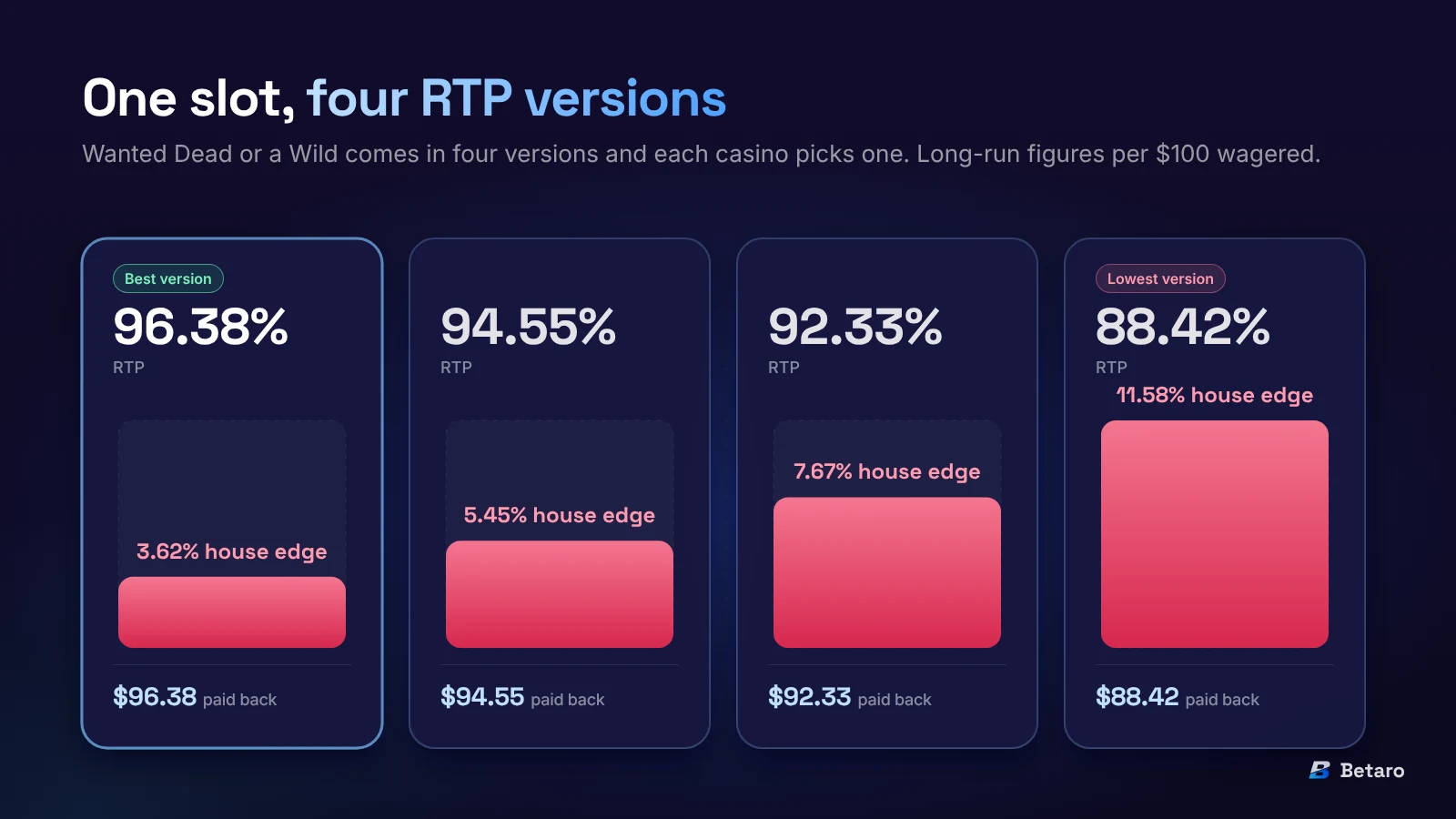
To show how RTP works in practice, let's take one of the most popular slots we track on Betaro: Wanted Dead or a Wild by Hacksaw Gaming. Its best version has an RTP of 96.38%, and it also comes in 94.55%, 92.33% and 88.42% versions. The casino decides which one you get.
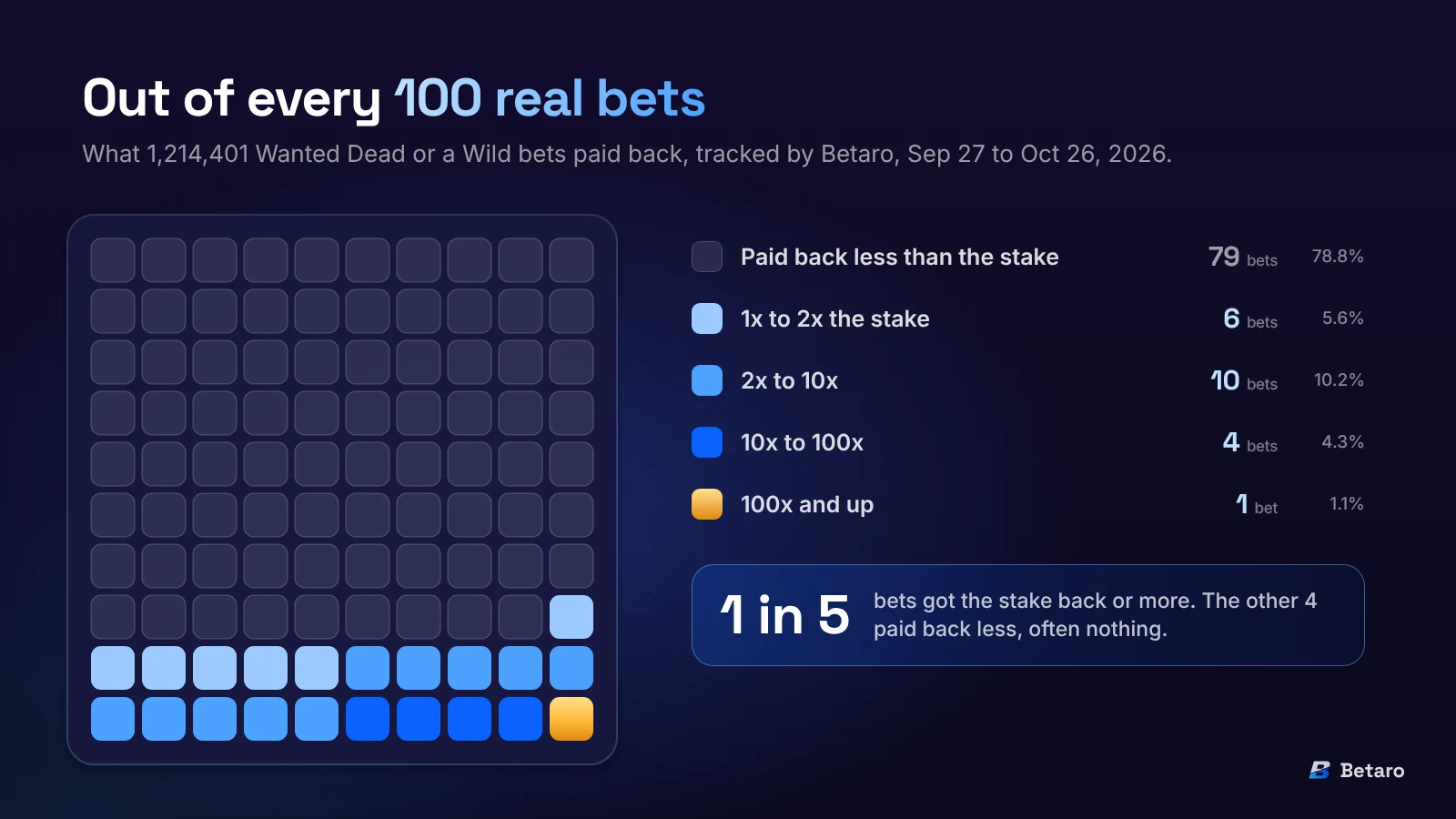
With a 96.38% RTP, a lot of beginners expect to get at least $96.38 back for every $100 they wager. The real payout numbers tell a different story. Below are the results of 1,214,401 real money bets we tracked in the 30 days to October 26, 2026.
| Result | Share of bets | How often |
|---|---|---|
| Paid back less than the stake | 78.8% | About 4 in 5 bets |
| Got the stake back or more | 21.2% | About 1 in 5 bets |
| Doubled the stake or more | 15.6% | 1 in 6.4 bets |
| Paid 100x or more | 1.1% | 1 in 87 bets |
| Paid 1,000x or more | 0.12% | 1 in 822 bets |
So 78.8% of the bets paid back less than the stake, often nothing at all, and only 21.2% returned the stake or more. In other words, each bet had roughly a 1 in 5 chance of breaking even or winning. The slot doesn't remember previous bets either. Every time you press spin you get the same odds: about 1 in 5 to get your stake back or more, and about 4 in 5 to lose part or all of it. If you split $100 into five $20 bets, each of those spins still has that same 1 in 5 chance.
So how does the slot still reach a 96.38% RTP? Through the rare big hits. In the same month, 13,900 bets paid 100x or more and 1,477 paid 1,000x or more. Those few wins make up a big part of what the slot pays back.
RTP Over Time: What Does It Actually Mean?
New players who read about high RTP slots often think the number applies to every session, but that's not the case. RTP is a theoretical figure worked out over a huge number of game rounds, so what you actually get back when you play can be very different. Here's a quick example:
- Player A bets a total of $50 on a slot with a 96% RTP and only gets $10 back.
- Player B bets the same $50 on the same slot and walks away with $80.
Both results are completely possible and well within the slot's rules and fairness. The $96 per $100 wagered only shows up over a long period of time and millions of spins.
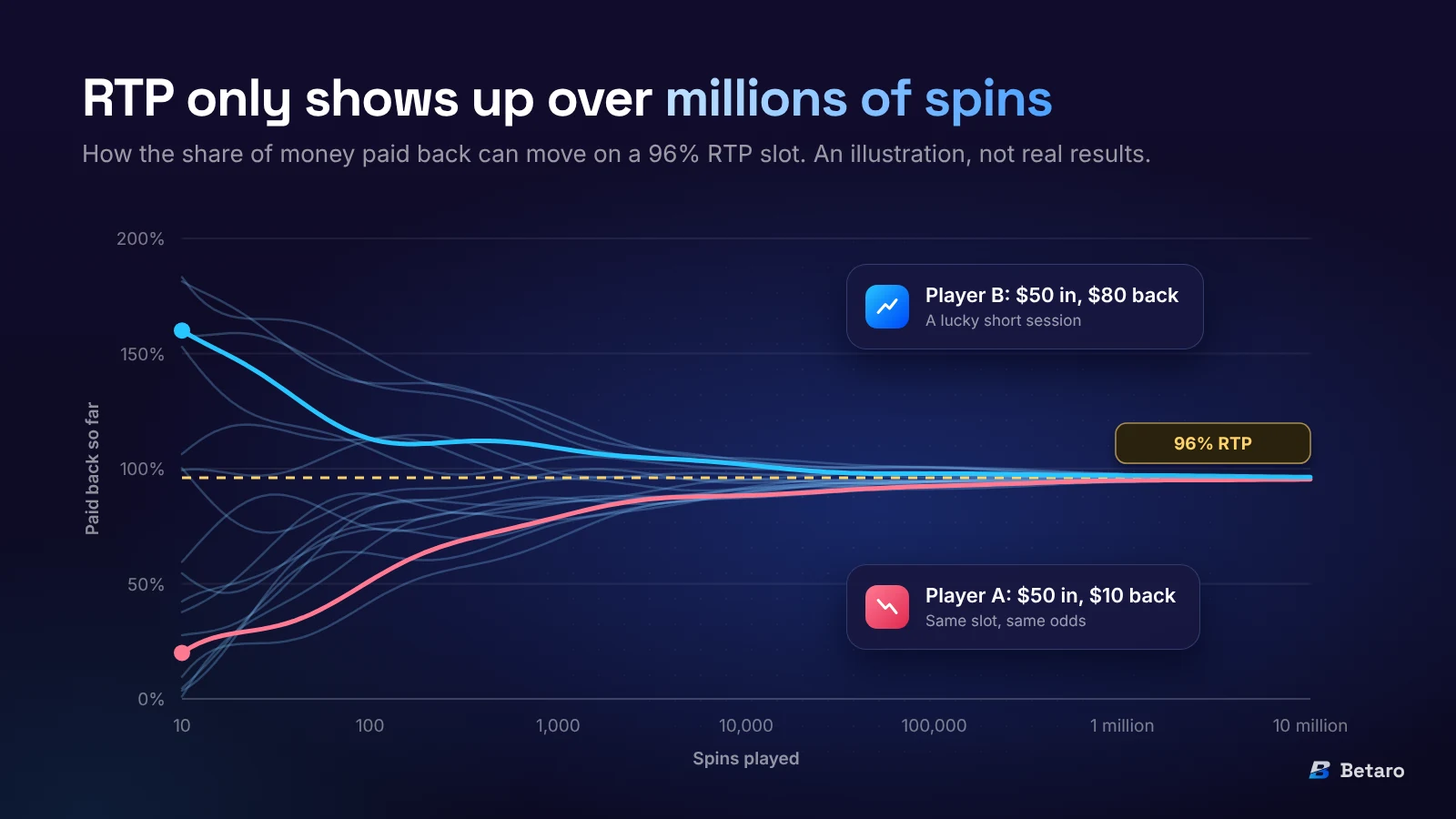
Keep in mind that a long dry spell doesn't mean a big win is around the corner. Every time you press spin, the random number generator decides the result without looking at what happened before.
RTP vs House Edge: What's the Difference?
The house edge is the theoretical percentage the casino keeps over the long run. It's the flip side of RTP, which is the theoretical share of wagers paid back to players as wins. You can work out the house edge of any slot with this formula:
- House edge = 100% - RTP
- Example: a slot with a 95% RTP has a house edge of 5% (100% - 95% = 5%)
Just like RTP, the house edge is calculated over millions of bets. It's a long-run average, so the casino doesn't take a fixed cut out of every bet you place.
This is also why the RTP version a casino picks matters. Over the long run, the best version of Wanted Dead or a Wild keeps $3.62 of every $100 wagered, while the lowest version keeps $11.58. That's more than three times as much, on exactly the same game.
How Do RTP and Slot Volatility Work?
RTP and volatility describe two very different things. RTP tells you the theoretical payout per $100 wagered over a long period of time. Slot volatility, on the other hand, tells you more about how often a slot pays and how big those wins tend to be. Studios rate it in their own ways, but the two ends of the scale look like this:
- Low volatility slots pay out more often, in smaller amounts. Some of them can still pay over 1,000x your stake.
- High volatility slots pay out less often, but when a win does land, it's more likely to be a big one.
RTP has no influence on a slot's volatility. Two games with the same RTP can have completely different volatility ratings. And neither one guarantees wins or a profitable session.
Can You Check the RTP of a Slot?
Yes, in most slots you can check the RTP before you place a bet. This is how you find it:
- Account: create an account at the casino you want to play at.
- Game: pick the slot you want and load it as if you were going to play.
- Info button: look for a small "i" button, usually near the bet controls. It opens the game rules, which often include the slot's RTP and volatility too.
Here's what that looks like in the Big Bass Halloween 3 demo on Betaro. The game rules show a theoretical RTP of 96.50%, list the Ante Bet and both bonus buys at 96.50% as well, and rate the game as medium volatility.
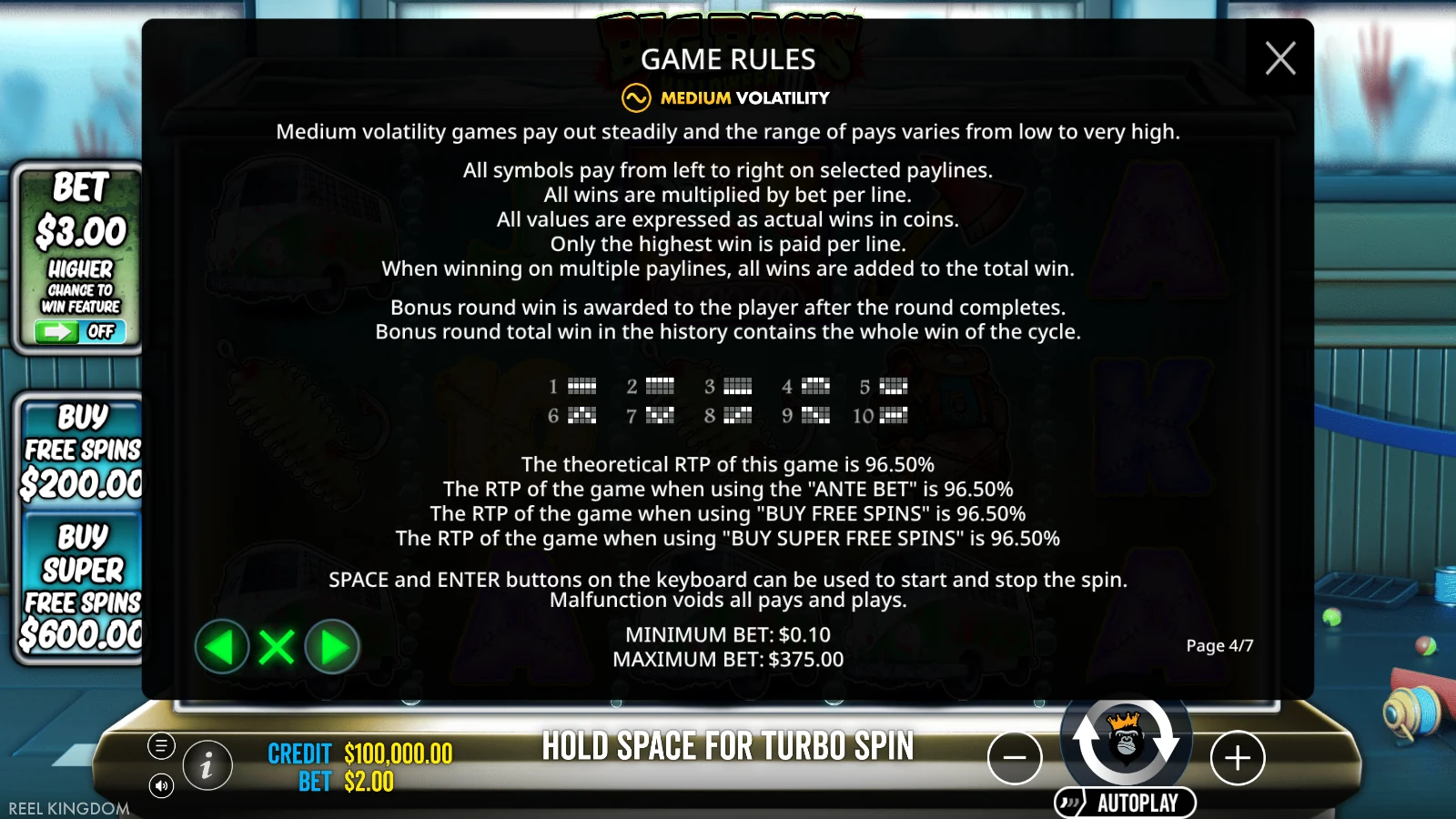
Pro tip: always check the RTP at the casino you're actually going to use. Big Bass Halloween 3 also comes in 95.50% and 94.50% versions, and like with many slots, the casino chooses which one it offers.
Does a Higher RTP Mean a Better Slot? An Expert's Opinion
A higher RTP is definitely the better pick when you're comparing two games. But it doesn't cover everything. If you're not into classic fruit slots, a fruit slot with a higher RTP still isn't the better game for you. To find the right choice, think about these things as well:
- Is it a type of slot you enjoy playing? (classic slots, Megaways, jackpot slots and so on)
- Does the minimum bet fit your budget and the way you like to play?
- Do you like the look of the game?
The best choice is a slot that ticks all of those boxes. If RTP is high on your list, our high RTP slots are a good place to start. I also always recommend trying a demo of a slot before you play it for real. That way you can discover all the features and mechanics without spending any of your own money. Most online casinos offer demos, and if yours doesn't, you can check if the game is among the 10,000+ demo slots on Betaro.
Questions and answers
What is a good RTP for slots?
For online slots, an RTP of around 96% or higher is generally considered good, and most online slots sit somewhere between 94% and 97%. A higher RTP means a lower house edge, but it doesn't decide your short-term results. Even on a high RTP slot you can still lose everything you wager in a session, or simply not enjoy the game.
What does 95% RTP mean?
A 95% RTP means the slot's theoretical payout is $95 for every $100 wagered over millions of spins. Those payouts can come as lots of small wins or a few big prizes. How much you've already spent on a slot has no influence on what you win next.
Can a slot's RTP change?
Yes, depending on where you play. Many slots come in several RTP versions and the casino picks one. Wanted Dead or a Wild, for example, comes in 96.38%, 94.55%, 92.33% and 88.42% versions, so the same game can pay back less at one casino than at another. Some slots also list a separate RTP for bonus buys or features like an ante bet in their game rules, so check those if you use them.
Is the RTP of an online slot the same as in a land-based casino?
Usually not. Slots in land-based casinos often have a lower RTP than their online versions. Those casinos have to cover costs like staff, energy and rent or a mortgage, and a lower RTP helps pay for that. Online casinos cost less to run, so they can offer higher RTP versions.
Does a higher RTP mean more frequent wins?
No. RTP only measures a slot's theoretical return over the long run. How often a slot pays is down to its volatility and hit frequency, so a slot with a high RTP can still go a long time between wins.
Slots mentioned in this post
Real-money gambling always carries risk, so only play with money you can afford to lose. Where a post uses Betaro data, our methodology page explains where the numbers come from.