

Not sure if high volatility slots are the right choice for you? Or are you confused about what volatility in slots really means? Then this guide will bring the clarity you need. Learn what volatility means, what the differences between high and low volatility slots are, and which option is best for your playstyle.
What Is Volatility in Slots?
The volatility of a slot shows you how often you can expect winning results when playing online casino games. It tells you more about how a game's payouts vary over time, including how often wins land and how big they are. This is a different characteristic from the RTP of a game. Two games with the same RTP can spread their payouts in very different ways, depending on their volatility. A low volatility slot will pay out smaller amounts more regularly, while a high volatility slot can go through long stretches without significant wins. However, this doesn't mean you can't land a big win on a low volatility slot.
The easy rule to keep in mind is: high volatility slots pay out less often, but with bigger prizes, while low volatility slots pay out regularly, but with smaller prizes.
What Are High Volatility Slots?
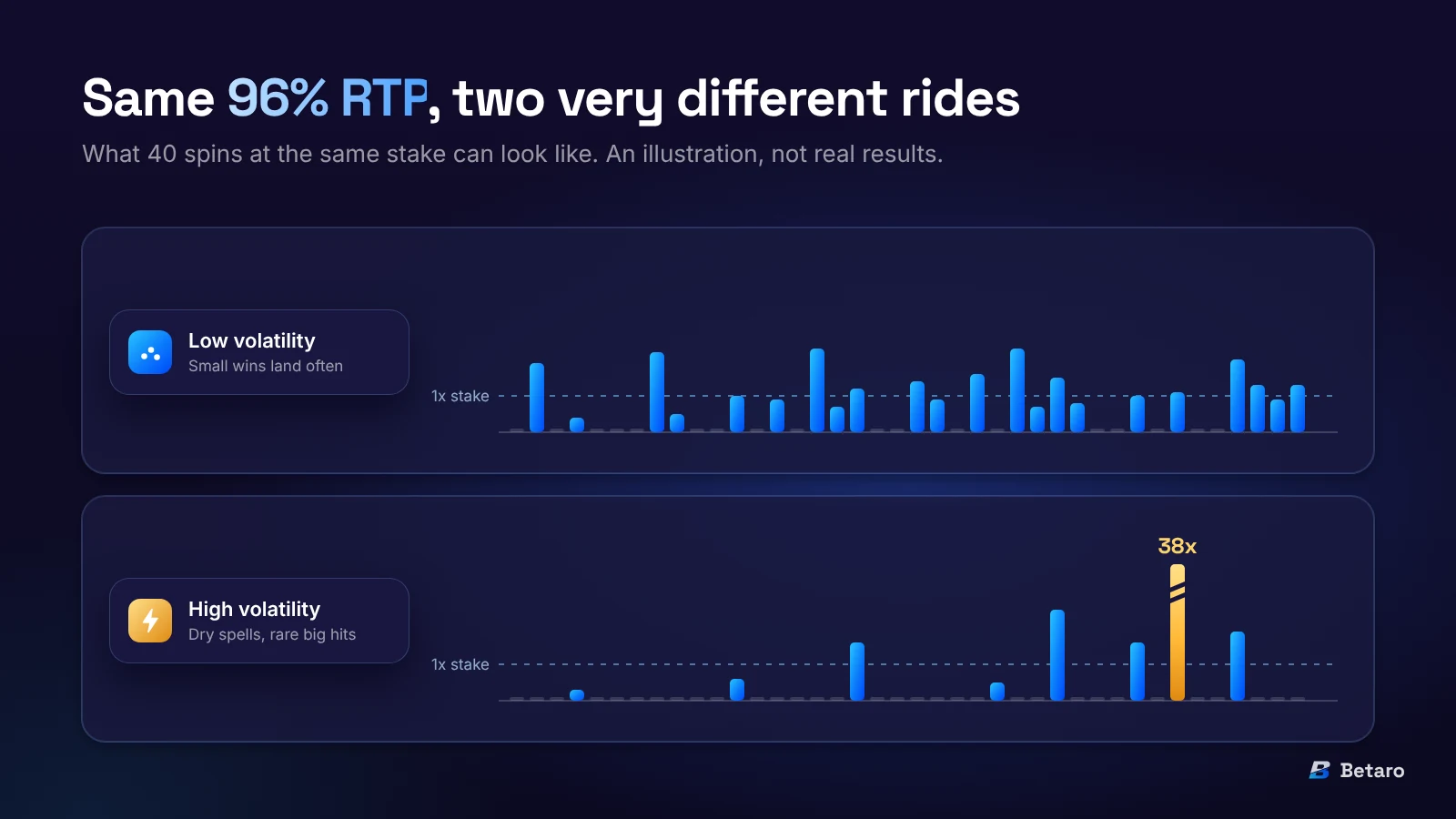
High volatility slots pay out small amounts less often, and instead produce rare and often larger prizes to reach their RTP. The prizes you win on these slots are often big compared to your stake. And since the payouts are less frequent, you might go through a "dry run", where you either win less than your stake or don't win at all.
This is why these slots are recommended for players who like taking risks for higher potential payouts. Below you can find some of the most popular high volatility slots:
- Wanted Dead or a Wild - Hacksaw Gaming (rated 4 out of 5)
- Gates of Olympus 1000 - Pragmatic Play (High)
- Duck Hunters - Nolimit City (Extreme)
- Sugar Rush 1000 - Pragmatic Play (High)
Pro tip: Don't assume a big win is just around the corner or will land on the next spin just because you haven't won in a while. A losing streak doesn't mean a big payout is due. The result of each spin is independent, so spending more money or going through a dry spell doesn't increase your chances of winning on the next spin.
How Wanted Dead or a Wild paid out in real bets
Below you can find the payouts of Wanted Dead or a Wild, based on 1,213,923 real money bets we tracked at 19 online casinos in the 30 days to October 27, 2026:
| Result | Bets | Share of bets |
|---|---|---|
| Paid back less than the stake | 956,123 | 78.8% |
| 1x to 2x the stake | 67,723 | 5.6% |
| 2x to 10x | 124,305 | 10.2% |
| 10x to 100x | 51,922 | 4.3% |
| 100x to 1,000x | 12,387 | 1.0% |
| 1,000x and up | 1,463 | 0.1% |
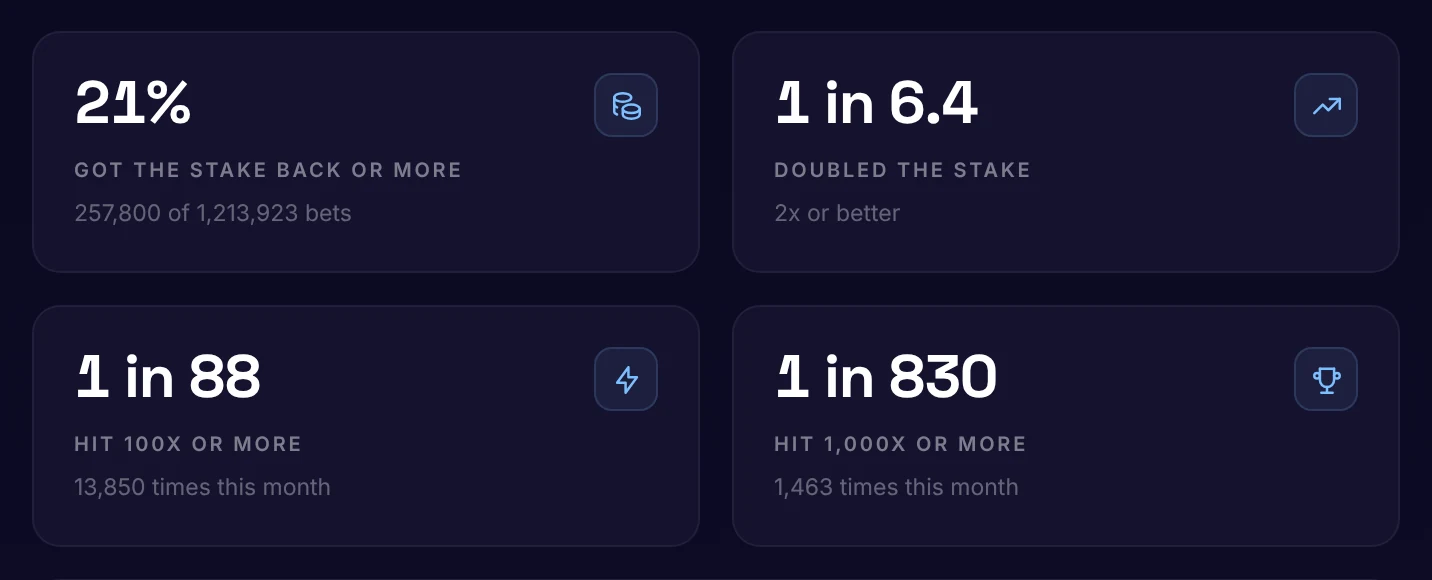
Almost 4 out of 5 bets paid back less than the stake, yet 1,463 bets hit 1,000x or more in the same month. That is high volatility in a nutshell.
What Are Low Volatility Slots?
You might have guessed it, but low volatility slots are the opposite of high volatility slots. They pay out more often, but in smaller amounts, often below your stake. With these slots, you usually lose money at a slower pace, while still getting plenty of "winning" spins. So a low volatility slot doesn't mean a profitable slot, and it doesn't mean you can't win big prizes either. For example, Sweet Bonanza Super Scatter has a low volatility rating from Pragmatic Play, but a max win of 50,000x your bet.
These slots are recommended for players who want to manage their bankroll as well as possible and enjoy longer play sessions. However, longer sessions or a lower chance of losing money aren't guaranteed. Some examples of low volatility slots are:
- Big Bass Bonanza - Pragmatic Play
- Master Joker - Pragmatic Play
- Chicken Chase - Pragmatic Play
High vs Low Volatility Slots: Key Differences
Below we've listed some of the key differences and similarities between these games. However, since slots are games of chance, your experience might be different from the general expectations of these online machines.
| Characteristic | Low volatility slots | High volatility slots |
|---|---|---|
| Typical payout pattern | More frequent, smaller wins | Less frequent, bigger wins |
| Short-term results | Generally less variable | Generally more variable |
| Losing stretches | Can happen | Often longer and more noticeable |
| Large-win potential | Depends on the game | Often linked to large potential payouts |
| RTP | Can be high or low | Can be high or low |
The overview shows that neither category is better than the other, they simply suit different play styles.
What the difference looks like in real bets
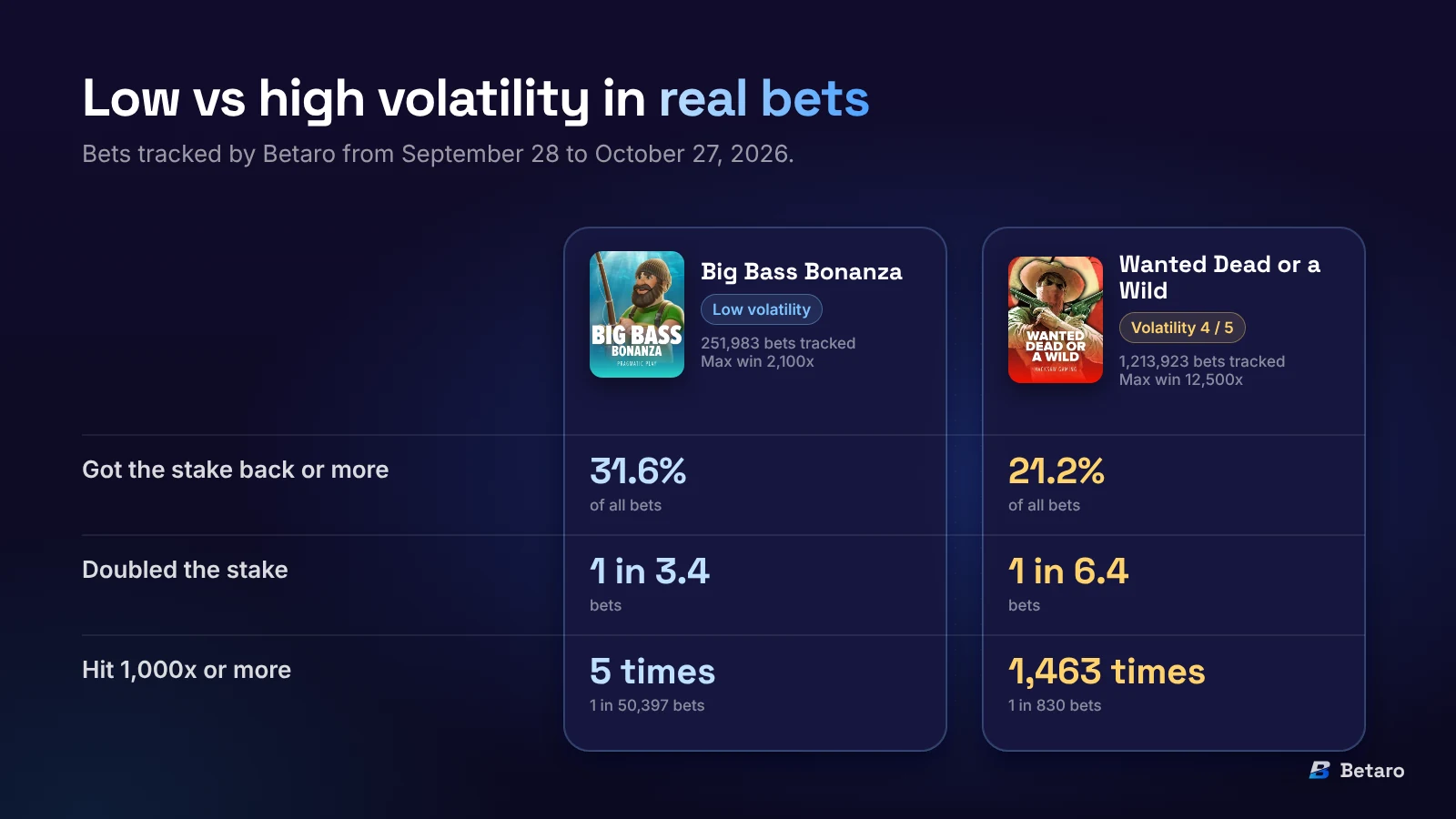
To show you what this means in practice, we compared two popular slots from our own data. Big Bass Bonanza is rated low volatility by Pragmatic Play, while Wanted Dead or a Wild is rated 4 out of 5 by Hacksaw Gaming. Big Bass Bonanza paid back the stake or more on 31.6% of bets and doubled it on 1 in 3.4 bets. But it only hit 1,000x five times in 251,983 bets. Wanted Dead or a Wild paid back the stake less often, but hit 1,000x or more 1,463 times.
Slot Volatility vs RTP: What's the Difference?
New players often mix up RTP and volatility and think that one influences the other. However, RTP and volatility measure two different things:
- RTP: RTP stands for return to player, and it's shown as a percentage. It's the theoretical payout percentage of a slot over millions of spins. A slot with a 96% RTP will pay out $96 for every $100 wagered in the long run. How that money is split between small and big prizes is up to the game's design.
- Volatility: Volatility tells you more about how often wins land and how big they are. Low volatility means more frequent but smaller payouts, while high volatility slots pay out less often but are more likely to pay out significant amounts.
Two slots can have the same 96% RTP but a different volatility, which means their payout patterns are completely different. Big Bass Bonanza and Wanted Dead or a Wild are a good example. Both come in versions with an RTP above 96%, but as the numbers above show, they pay out in very different ways. Want to learn more about RTP? Read our guide on how slot fairness and RTP work.
How to Check a Slot's Volatility
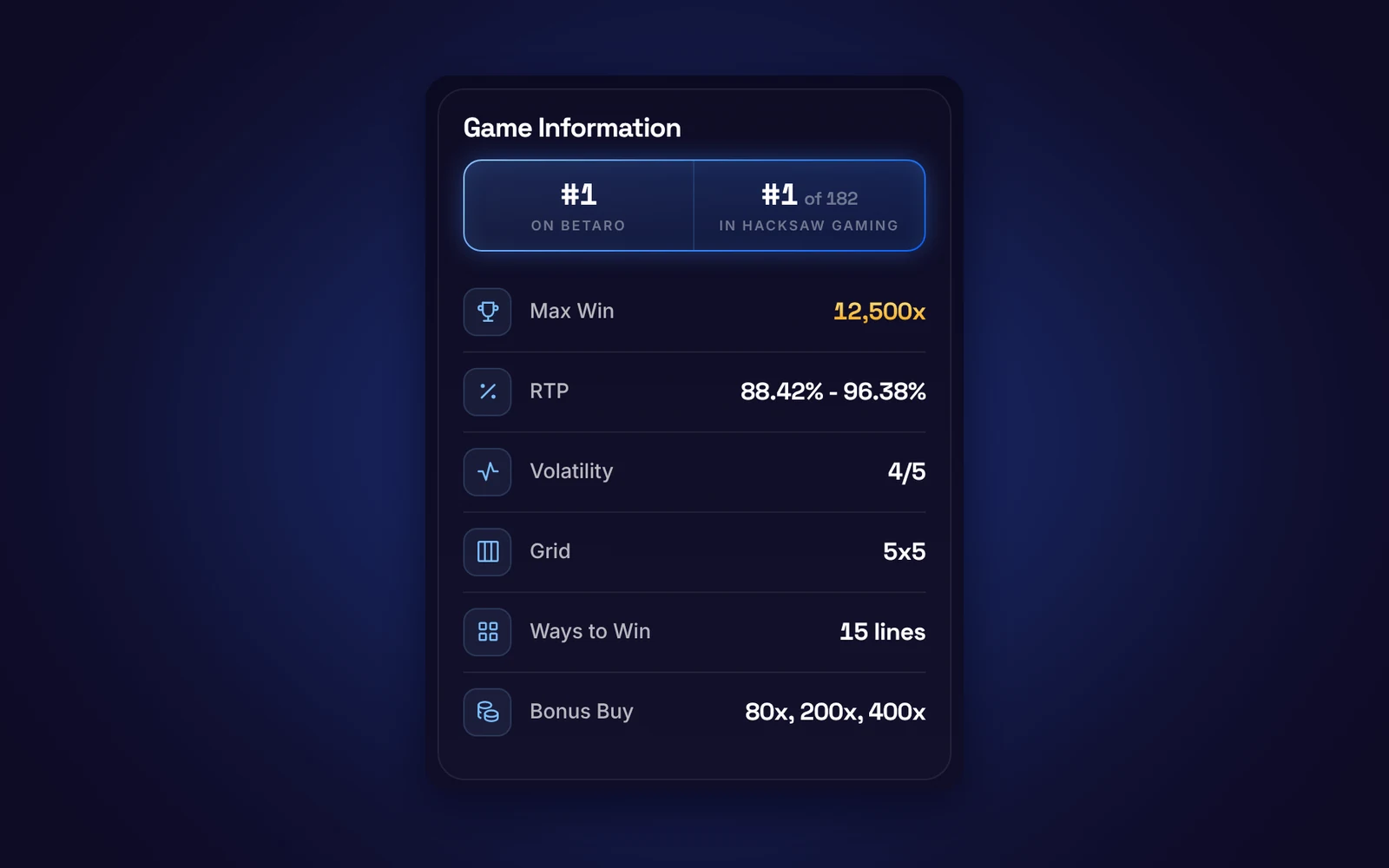
There are multiple ways to find out the volatility of a slot. One of the easiest is to visit the game page of your favorite slot on Betaro and scroll down to the game information. Here you can find essential details about each slot, such as bet limits, max win, RTP and volatility.
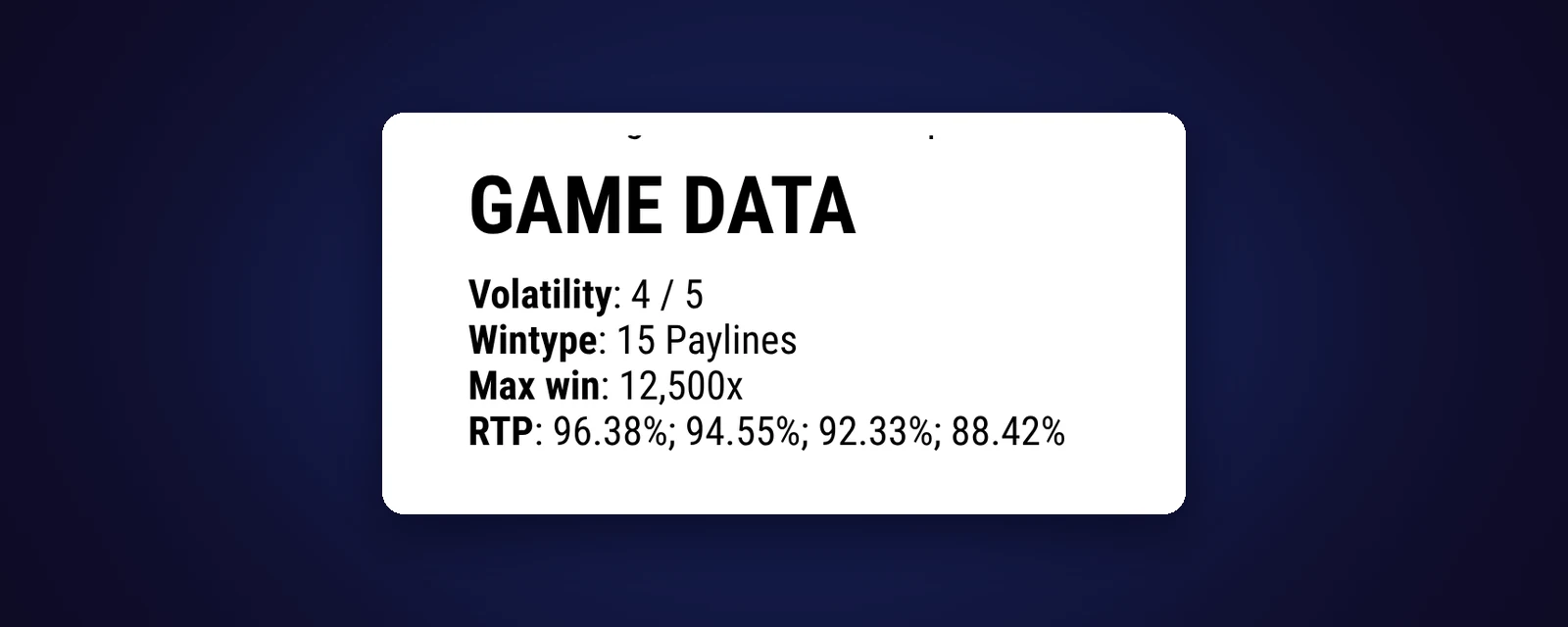
Another option is to visit the official page for the slot on the developer's website, where you'll find more information about the game and its volatility. Below is the game data for the popular slot Wanted Dead or a Wild, taken from the official Hacksaw Gaming site.
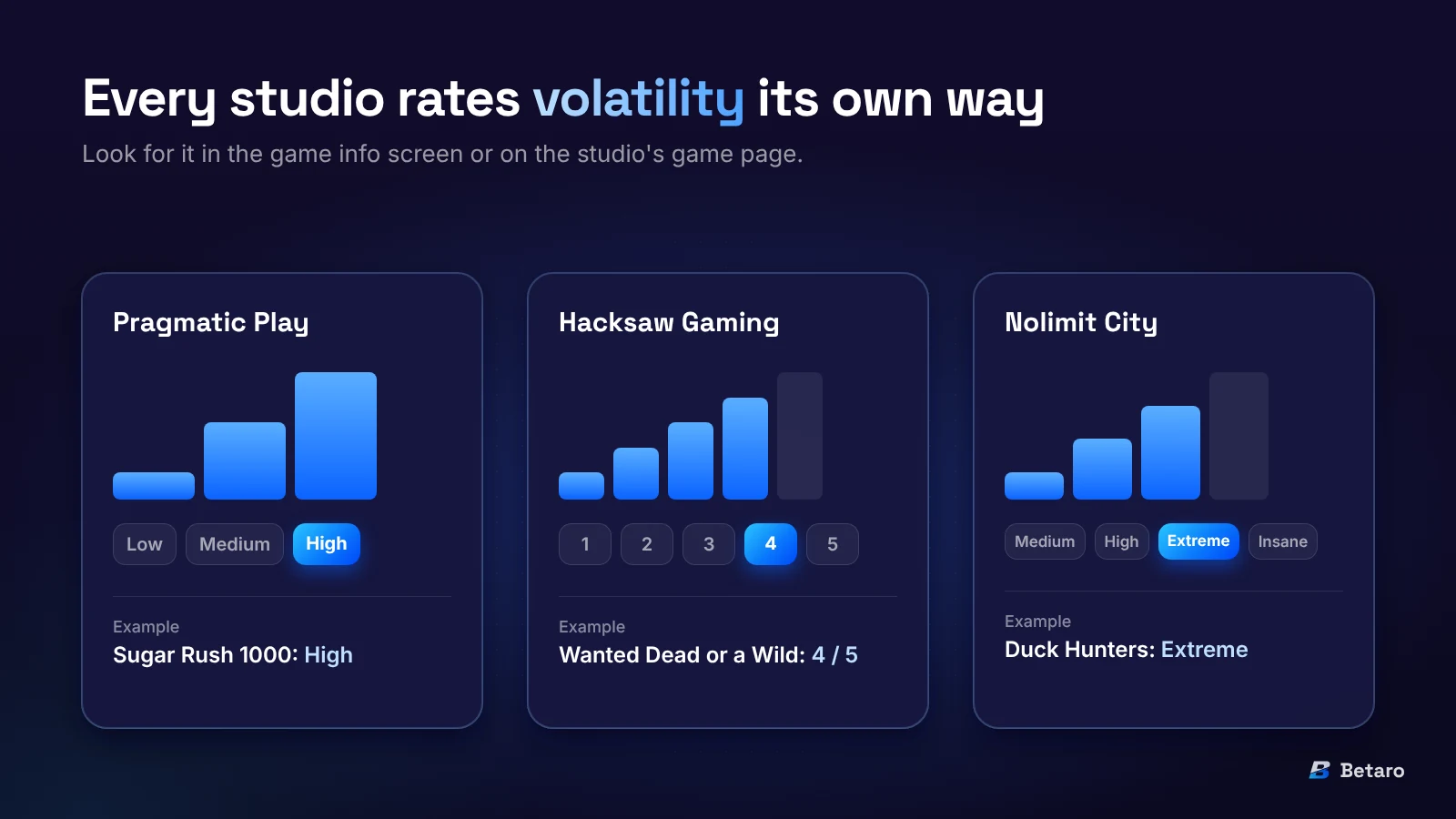
Keep in mind that not every studio uses the same scale. Pragmatic Play rates its slots low, medium or high, Hacksaw Gaming uses a score out of 5, and Nolimit City goes all the way up to extreme and insane.
Which Slot Volatility Is Right for You?
The answer to this question depends on your personal playstyle. Below we've listed the most common types of players:
- Risk takers: If you're a risk taker who likes to spend money for a potentially high reward, high volatility slots like Wanted Dead or a Wild are the best fit for you.
- Casual players: If you want to make your bankroll last or play with higher bets with a lower chance of losing your whole budget quickly, low volatility slots are the better choice. If you're looking for bigger payouts on smaller bets, high volatility slots are the better option.
- Beginners: Most beginners play on a smaller budget and want to make it last as long as possible. These players should choose low volatility slots for a better chance of longer sessions and an easier time managing their bankroll.
Whatever your playstyle is, we recommend trying a game for 30 minutes to an hour by playing the free demo version on our site. It gives you access to the full game and all of its bonus features. While playing the demo, you can experience both the dry runs of high volatility slots and the small payouts of low volatility slots. Once you're ready to play for real, you can visit your preferred casino and play for real money. Keep in mind that demo results are just as random as real money spins, so there is no guarantee you'll see similar results.
Expert's Conclusion on Slot Volatility
For this guide, I tested low, high and extremely high volatility slots and noticed a big difference in how the games paid out rewards. With low volatility slots, the hits of dopamine from a win were more frequent, but less emotionally charged. Even when I won between 2x and 10x my stake, it felt like "just another payout". Low volatility slots are a great choice for players who have limited funds or just want longer sessions.
The high volatility slots gave me some long dry runs, but when I won, the prizes were big enough to cover multiple rounds of spins, which made it feel "worth" the wait. I also noticed that the dopamine rush was a lot stronger when winning on these slots. The extra animations for a big win after a dry run in particular made me want to keep playing.
This is why I don't recommend high volatility slots to people with addictive tendencies, or to players who are gambling on a tight budget. You'll most likely burn through your bankroll before seeing a satisfying return. If you're not limited by a budget and like to take risks, high volatility slots can be a great way to enjoy gambling. Whatever you choose, only play with money you can afford to lose.
Questions and answers
What are high variance slots?
High variance slots are the same as high volatility slots. Variance is the mathematical term behind volatility, and both describe how often a slot pays out and how big those payouts are.
Can you win big prizes on low volatility slots?
Yes, depending on the game, you can still win large prizes on low volatility slots. For example, Sweet Bonanza Super Scatter has a low volatility rating and an RTP of 94.48% to 96.51%, with a max win of 50,000x your bet. Big wins are just less frequent than on high volatility slots.
Does high volatility mean a higher RTP?
No. Volatility and RTP measure different things. RTP is how much a slot pays back over millions of spins, while volatility describes how those payouts are spread out. A slot can have a high RTP with low volatility, or a low RTP with high volatility.
Are low volatility slots profitable?
No. Low volatility slots are designed to pay out more often but in smaller amounts, which doesn't make them profitable. You can still lose money, even if your sessions last longer.
Slots mentioned in this post
Real-money gambling always carries risk, so only play with money you can afford to lose. Where a post uses Betaro data, our methodology page explains where the numbers come from.